

Written by Mat O'Connor
Shopify is a great platform. I mean that genuinely.
For a huge range of ecommerce businesses it’s the right choice, and the speed at which you can get a well-performing store live on Shopify is genuinely impressive compared to the alternatives.
But every platform has limitations, and Shopify’s tend to get glossed over. Partly because Shopify’s marketing is excellent. Partly because a lot of agencies that sell Shopify implementations don’t want to complicate the conversation. And partly because the limitations often don’t become apparent until you’ve been on the platform for a while and start pushing against them.
These are the ones I see causing real problems for growing brands.
You don’t control your checkout
On standard Shopify, your checkout is Shopify’s checkout. You can change the colours, add your logo, and make minor cosmetic adjustments. That’s about it.
This matters more than most people realise when they’re choosing a platform. Your checkout is where buying decisions get finalised. It’s where trust needs to be at its highest, where friction needs to be at its lowest, and where the specific questions your customers have at the point of purchase need to be answered.
If your checkout needs custom fields, specific trust signals, a particular layout, or anything beyond the basics, standard Shopify can’t do it. Shopify Plus opens up checkout extensibility, but that’s a significant jump in cost.
For brands where checkout optimisation is a meaningful part of their CRO strategy, this is a real constraint.
URL structure is fixed
Shopify has a fixed URL structure. Products live at /products/product-name. Collections live at /collections/collection-name. You can’t change this.
For most brands starting fresh, that’s fine. But for brands migrating to Shopify from another platform, it can create significant SEO problems. If your current site has years of equity built up in URLs that don’t match Shopify’s structure, redirects can only do so much.
It’s also a limitation for brands with complex catalogue structures that don’t map neatly onto Shopify’s collections model. You end up working around the platform rather than with it.
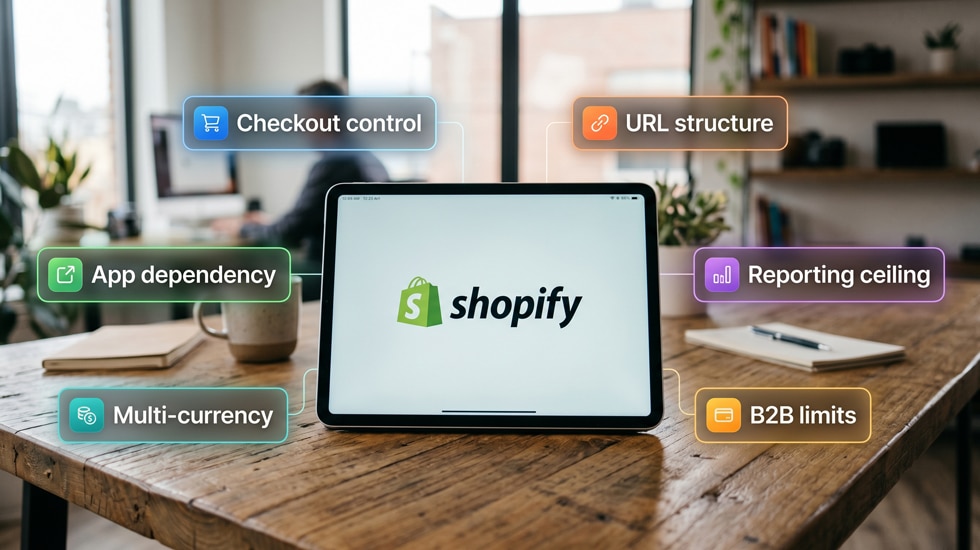
The app dependency problem
Shopify’s app ecosystem is one of its selling points. Almost any functionality you need exists as an app. But the more apps you install, the more problems you accumulate.
Every app adds code to your store. That code loads for every visitor, often whether the feature is relevant to that page or not. Performance degrades. Conflicts emerge. You end up paying monthly fees for five apps that partially overlap in what they do because none of them does exactly what you need.
The app model also creates fragility. An app you depend on gets acquired, changes its pricing, or stops being maintained. You either pay the new price, find an alternative and migrate your data, or go without.
Brands that have been on Shopify for three or four years and haven’t actively managed their app stack are almost always running more apps than they need, paying for more than they should, and experiencing slower page speeds because of it.
Reporting has a ceiling
Shopify’s built-in reporting is reasonable at lower volumes. As your business grows and your data questions get more complex, it starts to show its limits.
Cohort analysis, custom attribution models, detailed segmentation, revenue breakdown by channel and product type in the same view. These things require either Shopify Plus, third-party analytics tools, or both.
For brands that are serious about using data to make commercial decisions, Shopify’s native reporting often isn’t enough. That’s fine if you have a separate BI setup. But it’s worth knowing before you’re on the platform and wondering why you can’t get the answer to a question that seems straightforward.
Multi-currency and international gets complicated fast
Shopify has improved its international functionality significantly with Shopify Markets. But running a genuinely localised multi-market operation on Shopify is still more complicated than the platform’s marketing suggests.
True localisation means different product ranges, different pricing logic, different promotional mechanics per market. Shopify can handle some of this but not all of it natively. You end up using multiple stores, third-party apps, or both.
For brands with straightforward international requirements, same catalogue, same pricing adjusted for currency, it works well. For brands with more complex international operations, the limitations become apparent quickly.
Customisation has a ceiling
Shopify is a hosted platform. That’s one of its strengths. Infrastructure, security, and performance are handled for you.
But it also means you’re operating within Shopify’s rules. There are things you simply cannot change about how the platform works at a structural level. Checkout logic, URL structure, the way the cart functions, certain backend workflows. If your business has requirements that fall outside what Shopify allows, you either build a workaround, use an app, or accept that the platform can’t do it.
For most retailers this isn’t a problem. For brands with genuinely complex or unusual requirements, it can be a significant one.
B2B has improved significantly – but still has limits
Worth flagging separately because it’s changed recently. Until April 2026, native B2B functionality on Shopify was largely a Shopify Plus feature. That’s no longer the case.
Merchants on Basic, Grow, and Advanced plans now have access to company profiles, up to three B2B catalogs with customer-specific pricing, payment terms, volume pricing, and vaulted credit cards. For brands running a straightforward wholesale operation alongside their retail store, this may now be enough natively.
What’s still Plus-only is the more complex stuff. Unlimited catalogs, direct catalog assignment, partial payments, and deposits. If your wholesale operation is complex, Plus is still the right answer. But the gap between Plus and non-Plus B2B capability has closed significantly, and it’s worth reassessing if B2B was the main reason you were considering a platform change or a Plus upgrade.
None of this means Shopify is the wrong choice
These aren’t reasons to avoid Shopify. They’re things to understand before you commit to it so you’re not surprised when you hit them.
For brands in the right range, straightforward retail, manageable complexity, strong desire for a platform that’s easy to operate and fast to develop on, Shopify is excellent. The limitations above either won’t apply or won’t matter enough to outweigh the benefits.
But going in with a clear-eyed view of where the platform’s edges are means you make better decisions about app selection, about what to customise and what to leave alone, and about whether Shopify is still the right fit as your business grows.
The brands that get frustrated with Shopify are almost always the ones who hit a limitation they didn’t know existed. Understanding them upfront saves a lot of pain later.