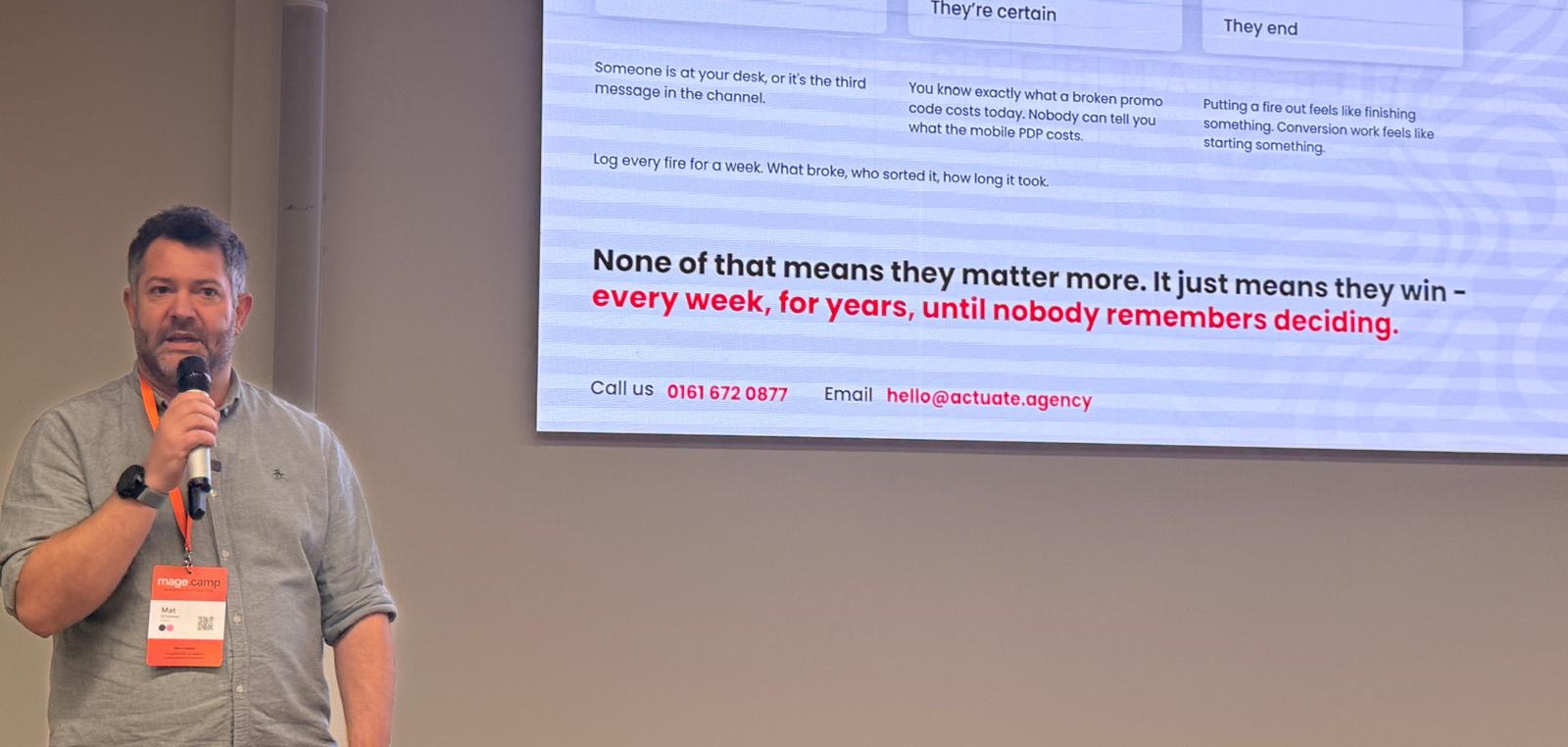

Nine minutes isn’t long to tell a room full of Magento people that most retainers are on fire. I gave it a go anyway at Mage Camp in Manchester on 14 October.
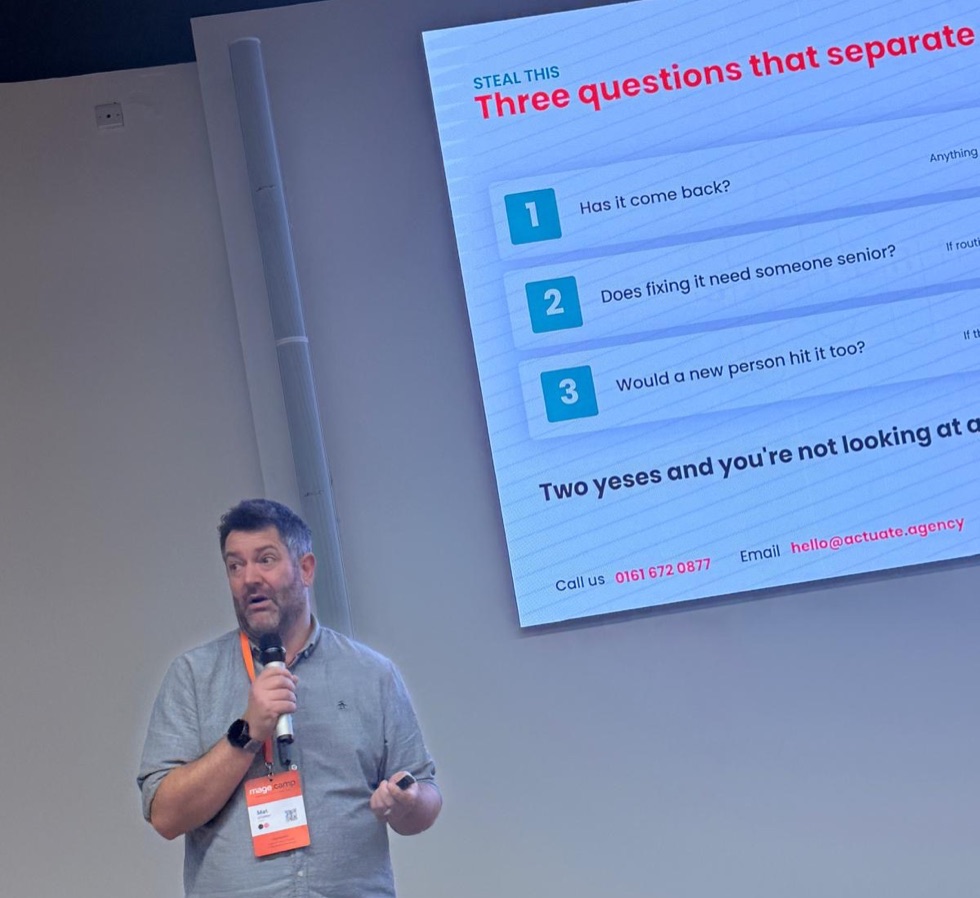
It was a cut-down version of the talk I gave at eCommerce Expo in September. Every eCommerce team has two lists. One is the work they want to do, like a better checkout, proper testing and a product page that sells. The other is the fires, from the broken product feed to the patch that knocked out half the extensions. The fires win every time because they’re loud, they’re certain and they end. So I gave the room three questions to tell a symptom from a root cause. Has it come back? Does it need somebody senior? Would a new starter trip over it? Two yeses and you’re patching a symptom.
What the developers said
The feedback afterwards was brilliant, and a lot of it came from developers. The gist was the same each time. They wished the agencies they work for approached it the same way.
I think that’s because developers are the ones who live with the fires. They know which ticket is the same bug wearing a different hat, and they can usually tell you the root cause in one sentence. What they don’t often get is the time or the budget to fix it properly, because the next fire’s already in the queue.
So if you’re running an agency, ask your developers which three things they’d fix for good if they had a fortnight. Then find them the fortnight.
A proper Magento day up North
It was also great to see this much focus on Magento up North. Mage Camp was co-organised by On Tap, PushON, Gene, Foundation Commerce and Monsoon Consulting, with the Magento Association and Manchester Digital behind it. Merchants got in free. That’s a lot of agencies who’d normally be pitching against each other putting a day on together, which says something good about the community here.
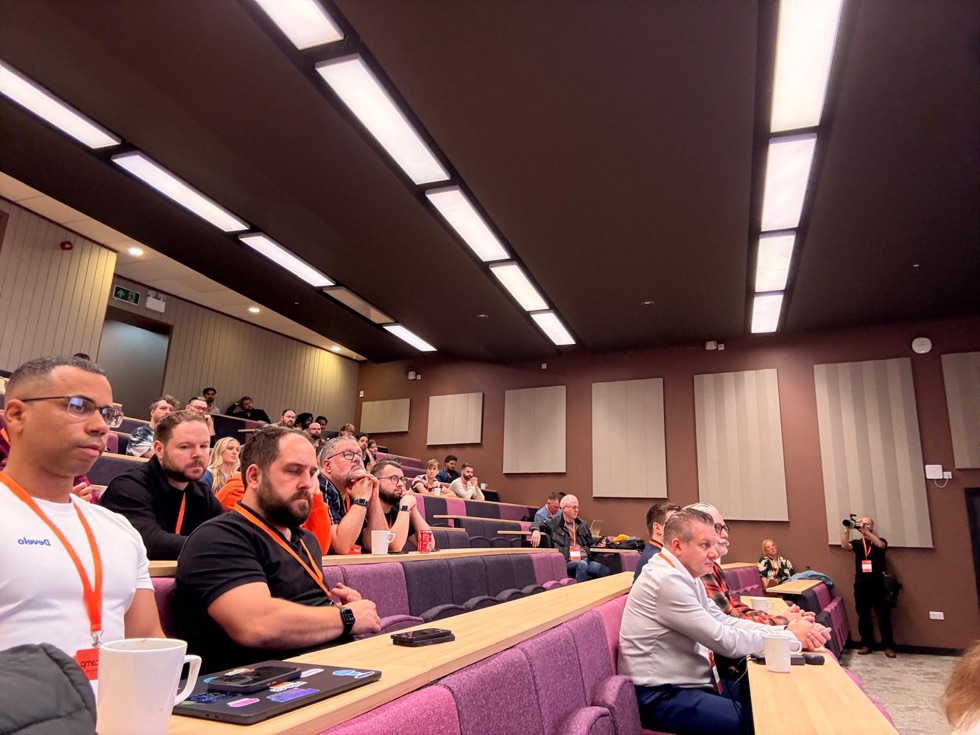
The talks were great right through the day, and a few have stuck with me.
Phil Knight from Haier Europe opened with “The Website Is the Easy Bit”, which is about as close to my own view as a keynote gets. His point was that transformation stalls when the teams behind the site don’t pull in the same direction, and that the technology is rarely what holds it up.
Karlijn Löwik from RUMvision gave “Sitespeed Casino – Know when to stop (investing)”. I spend a lot of my time telling people to make their sites faster, so it was good to hear someone with real-user data argue the other side. Her argument was to stop chasing a perfect Lighthouse score and find the point where the money stops coming back.
The lightning session I was in had some cracking company. James Allen-Lewis from Wind & Kite showed how Lewmar rebuilt their B2B site around their buyers, with more than eight million prices to handle. Adam Hindle from Fluid Commerce made the case for B2B portals as a growth tool rather than a place to check invoices. Maxine Tremain from Gene talked about what your roadmap leaves out, which is the fire log conversation from the other end.
John Hughes from Hyvä took on content and the CMS in “Good Stores Begin With Great Content (And the Right CMS)”. And Matt Sims from Ever-So-Lean closed the day with “When Your Customers Move On: The Cost of Standing Still”, which was the right note to finish on.
It’s good for the North to have a day like that of its own, with merchants, agencies and developers in the same room, and Manchester did it properly.
Why it matters for merchants
Every hour a developer spends fixing the same problem twice is an hour that isn’t going on growth. Fix the root causes and those hours go into the list on the left. That’s where the CRO work happens, and it’s what gets you to the problems worth having, like staffing up for the orders.
Thanks to everyone who organised it, and to everyone who came and found me afterwards. If you missed it, the full version of the talk is on our blog.
How much of your developers’ week went on fires rather than growth?